Bichongos
Full Stack Developer
The problem
Bichongos is a gourmet and functional mushroom cultivation project in Guarne, Colombia, with technical guidance from Songo Sorhongo. Mushrooms available on the market — imported or artisanal — are grown "blind," with no traceability or cultivation data. Bichongos does it differently: IoT-controlled capsules (temperature, humidity, CO₂, light) with full batch traceability via QR.
The site needed to solve two needs at once: a public landing page presenting the project — the value proposition, how it works, the product — and, in parallel, an admin panel where trained staff could manage cultivation day to day. Two audiences, two access levels, one system.
The solution
I designed and built the project end to end: architecture, data model, authentication, design system, and deployment, with Claude Code assisting throughout — from researching against live documentation to code and security review on every delivery.
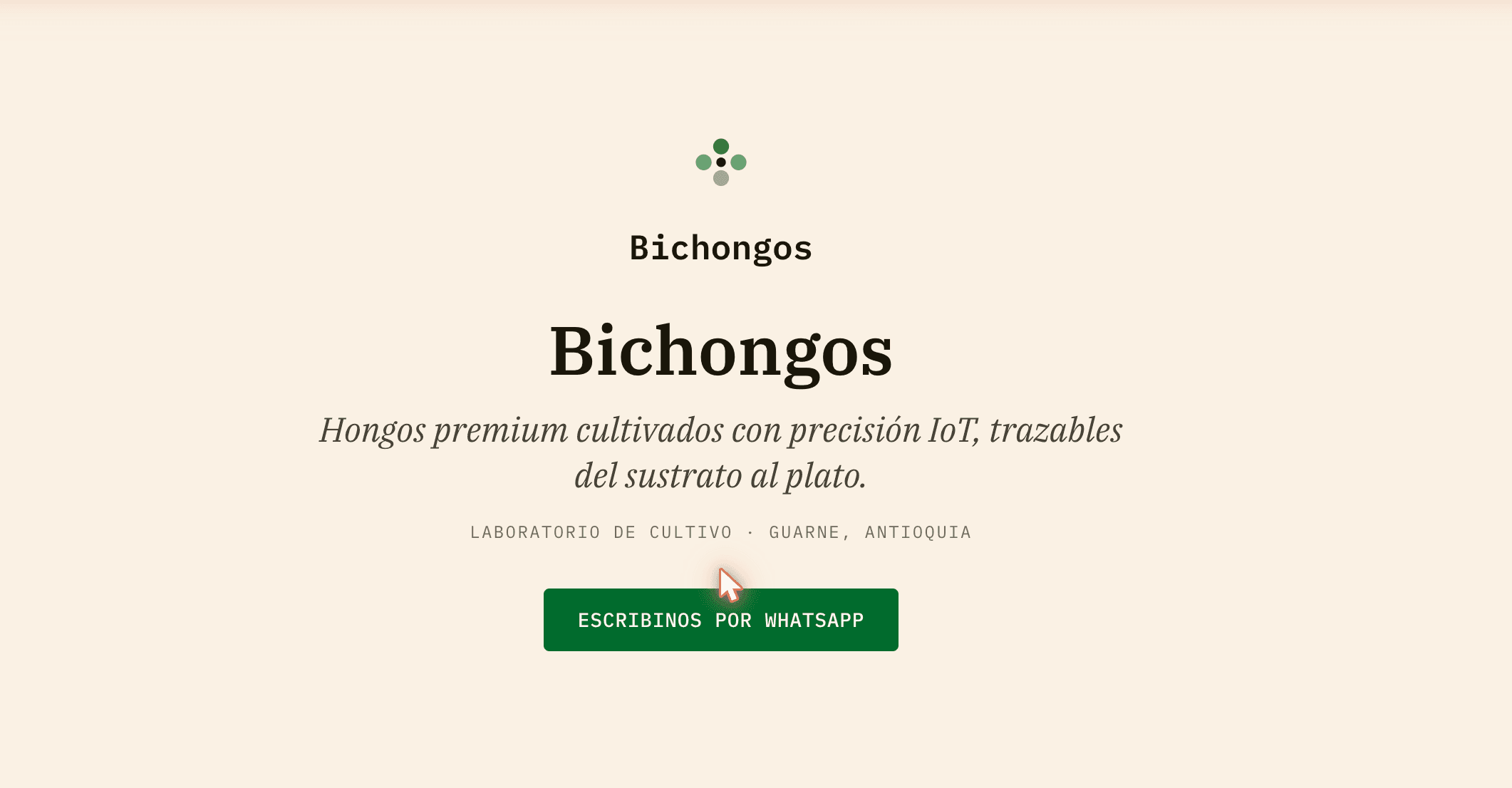
The landing page covers hero, value proposition, "how it works," and product, with SEO, responsiveness, and accessibility as first-class requirements, not later polish. Behind it, the /admin panel implements Google OAuth login, differentiated roles, and manual access approval — the foundation the next epics will build on: cultivation management, training, and IoT telemetry.
The visual identity is a custom design system: color tokens in oklch, IBM Plex Serif/Mono typography, and an SVG logo with four variants.
Technical decisions
RLS audited in depth, not assumed — while implementing roles, a review caught and fixed two real vulnerabilities before production: a policy that let any user self-assign the admin role, and infinite recursion in the admin policies that would have broken every query against the profiles table. Both were resolved with a trigger that blocks unauthorized role changes and a SECURITY DEFINER function that breaks the recursion without opening security holes.
Auth built against live documentation, not memory — Next.js replaced middleware.ts with the new proxy.ts convention, and Supabase now recommends getClaims() (local JWT validation) over getUser()/getSession(). I verified both against current documentation and the installed packages' source code before implementing.
Fail-closed authorization gate — the /admin panel is shared by three roles, not just admin. An automated security scanner suggested a fix that would have broken access for the other two legitimate roles; instead I identified and fixed the real bug: an unresolved profile was failing open, granting access instead of denying it.
WCAG AA contrast verified mathematically — brand colors were reviewed with real contrast calculations (oklch → relative luminance via the W3C formula), not by eye. The exercise found and fixed a button that failed the AA threshold for normal text.
Results
The first three epics are complete: foundations, public landing page, and role-based authentication. The admin panel (user and role management) is under construction, with cultivation management, training, IoT telemetry, and quality/operations as the next epics.
The entire login flow was tested live, end to end, before closing out the feature: automatic profile creation, role gating in both directions, and logout. The most valuable part of the exercise wasn't any single feature, but the discipline of verifying instead of assuming — in RLS security, in official documentation recommendations, and in color contrast.